A successful Idaho roofing claim isn't won when the storm hits; it's won through the professional documentation you provide to your insurance adjuster. Most homeowners feel a wave of anxiety when they spot shingles in the yard, fearing their claim will be denied or that they'll be stuck with thousands in costs beyond their deductible. We understand that the roofing insurance claim process Idaho requires can feel like a maze of technicalities and fine print. You want your home restored to its original condition without the constant stress of wondering if you're being treated fairly by your provider.
This guide is designed to help you secure the full coverage you deserve while protecting your home from low-quality repairs. We'll explain the critical differences between Replacement Cost Value (RCV) and Actual Cash Value (ACV) policies so you aren't surprised by the final payout. You'll also learn about Idaho’s three-year statute of limitations for property damage and how the adoption of the 2024 International Residential Code affects your restoration. By the end, you'll have a clear timeline for your project and the confidence to avoid local "storm chaser" scams that often follow a major weather event.
Key Takeaways
- Identify the specific types of damage common to Eastern Idaho, such as shingle blow-offs and hail bruising, to ensure nothing is missed during your initial inspection.
- Learn the step-by-step roofing insurance claim process Idaho residents follow to secure a full replacement while avoiding common pitfalls that lead to claim denials.
- Compare Replacement Cost Value (RCV) and Actual Cash Value (ACV) to understand exactly how your specific policy dictates your out-of-pocket expenses.
- Gain professional tips on managing the insurance adjuster meeting, including why having your contractor on-site is essential for a fair assessment.
- Understand the "two-check" payout system and how to handle supplemental costs for hidden damage found during the actual roof replacement.
Immediate Steps After Idaho Storm Damage
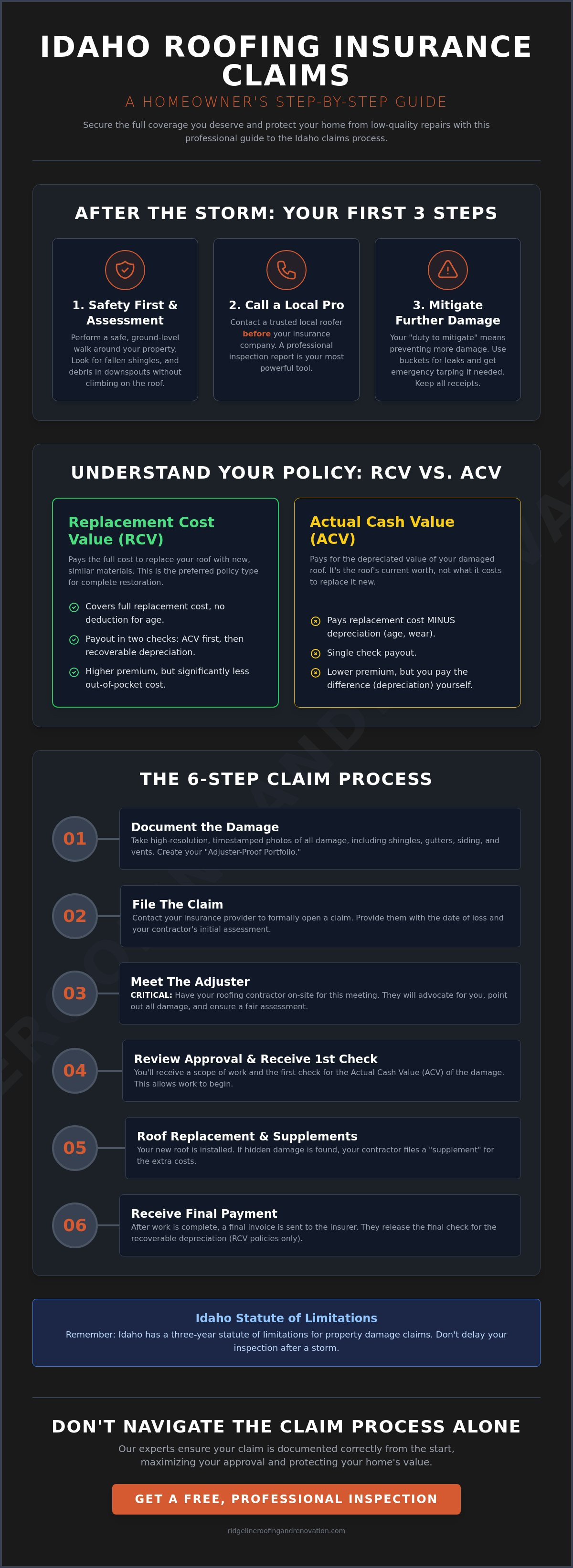
The storm has passed, but the work is just beginning. Your priority should be a safe, ground-level assessment of your property. Walking around the perimeter of your home allows you to spot obvious issues without risking a fall. Look for shingles on the lawn or bits of grit near your downspouts. These are often the first signs that the roofing insurance claim process Idaho homeowners face will be necessary for your property.
Successfully starting the roofing insurance claim process Idaho requires patience and clear evidence. It’s essential to contact a local roofing professional before you call your insurance company. A local expert understands how Eastern Idaho’s unique weather patterns, like the high-velocity winds in Idaho Falls, impact different materials. They can provide a detailed report that serves as a foundation for your claim. This professional documentation bridges the gap between your initial worry and the technical requirements of an insurance adjuster. Understanding the homeowners insurance claims process helps you stay ahead of potential denials by ensuring your evidence is thorough from day one.
Identifying Wind and Hail Damage in Eastern Idaho
Identifying damage correctly ensures your home stays compliant with the 2024 International Residential Code, which Idaho has adopted. Damage in our region often takes specific forms that an untrained eye might miss. Hail bruising on asphalt shingles looks like dark, soft spots where the protective granules have been knocked away. This exposes the underlying mat to UV rays, which leads to leaks over time. High winds can also lift shingles, breaking the sealant bond even if the shingle doesn't blow off completely. Don't forget to check your gutters and siding for small dents. These "collateral" marks are vital evidence that proves the severity of the storm to your insurance provider.
Safety and Temporary Repairs
Your safety is the highest priority. Never climb onto a wet or damaged roof without professional safety gear and training. Instead, focus on your legal "duty to mitigate." This means you must take reasonable steps to prevent further interior water damage while your claim is pending. If you have an active leak, use buckets to catch water and move valuables away from the area. If emergency tarping is required, keep every receipt and take photos of the tarp in place. Properly documenting these temporary measures ensures they are included in your final reimbursement. This proactive approach keeps your home dry and shows the insurance company you are acting responsibly to protect the structure.
Documenting Damage: The Adjuster-Proof Portfolio
Collecting evidence is the most critical phase of the roofing insurance claim process Idaho homeowners must navigate. An adjuster-proof portfolio isn't just a handful of blurry cell phone pictures. It's a methodical collection of high-resolution, timestamped photos that tell a clear story of the storm's impact. Start with wide shots of each side of the house, then move in for close-ups of damaged shingles, dented gutters, or cracked vents. This level of detail removes guesswork and prevents the insurance company from claiming the damage was pre-existing.
Don't overlook collateral damage. Insurance carriers often look for signs of impact on softer materials like vinyl siding, metal downspouts, or wooden fences to validate a roof claim. If a hailstone was large enough to dent a heavy-duty gutter, it was certainly large enough to bruise an asphalt shingle. You should also pull a local weather report to verify the exact date of loss. Providing a professional weather report alongside your photos aligns perfectly with the recommendations found in the official Idaho Post-Disaster Claims Guide, which serves as a vital resource for navigating these complex situations. If you are unsure how to start your documentation, our team can provide a professional inspection to identify every point of concern.
The Role of Professional Inspections
A contractor-led inspection often finds subtle damage that a busy insurance adjuster might miss. We use drone photography to document hard-to-reach roof slopes and steep pitches safely, ensuring every square inch of your roof is accounted for. This bird's-eye view is especially helpful for identifying the specific patterns of wind damage roof repair Idaho Falls residents frequently encounter. Having a professional damage map ready for the adjuster shows that you are prepared and serious about your home's restoration.
Organizing Your Claim Paperwork
Organization is your best defense against confusion or delays. Keep a dedicated log of every phone call, email, and meeting with your insurance company. Be sure to store receipts for any immediate out-of-pocket expenses, such as emergency tarping or minor leak repairs. When you submit your claim, write a clear, fact-dense sentence describing the event. For example: "On May 15, 2026, a severe hailstorm with one-inch stones caused visible bruising across the north slope of my roof and dented the aluminum gutters." This clarity helps the roofing insurance claim process Idaho move forward without unnecessary back-and-forth communication.
Understanding Your Policy: RCV vs. ACV in Idaho
Before you sign a contract for your roofing insurance claim process Idaho, you must understand the financial structure of your insurance policy. Most homeowners assume their insurance will pay for the entire roof, but this depends heavily on whether you have a Replacement Cost Value (RCV) or an Actual Cash Value (ACV) policy. RCV covers the full cost of replacing your roof with new materials. In contrast, an ACV policy only pays what your roof is worth today, accounting for years of wear and tear. This depreciation can leave you with a significant bill that goes far beyond your standard deductible.
The Idaho Department of Insurance (DOI) plays a vital role in protecting you during this process. They ensure that insurance companies operate fairly and maintain the financial stability required to pay out major claims. As of January 2026, new state legislation (HB 71) has increased oversight of large insurance companies. The state now monitors the financial health of the entire corporate structure, ensuring they remain dependable even after widespread regional disasters. If you feel an insurer is acting in bad faith, the DOI serves as your primary advocate for resolving disputes and ensuring your claim is handled according to state law.
Depreciation and Recoverable Payouts
If you have an RCV policy, you'll likely encounter "recoverable depreciation." This is the portion of the claim the insurance company holds back until the work is finished. They send an initial check for the depreciated value, and then you must provide a final invoice to "release" the remaining funds. It's a common point of confusion that often leads to anxiety about out-of-pocket costs. Without an RCV policy, that depreciation is "non-recoverable." This means the homeowner is responsible for the entire difference between the depreciated value and the actual cost of a modern roof replacement.
Idaho-Specific Policy Considerations
Idaho’s adoption of the 2024 International Residential Code (IRC) means your new roof may need to meet stricter standards than your old one. You should check your policy for "Ordinance or Law" coverage. This specific clause covers the extra costs associated with bringing a roof up to current local building codes during a repair. Additionally, be aware of "anti-concurrent causation" clauses. These can be tricky in Idaho weather; they may limit coverage if damage is caused by two events simultaneously, where only one is a covered peril. Reviewing these details with a professional helps you set realistic expectations for your final payout.
The Insurance Adjuster Meeting: Tips for Homeowners
The meeting with the insurance adjuster is the pivotal moment in the roofing insurance claim process Idaho homeowners must navigate. This is when the documentation you've gathered meets the insurance company's evaluation. While the adjuster’s role is to assess the damage based on your policy limits, they are often handling dozens of claims a week. This high volume can lead to missed details or overlooked "collateral" damage on vents and flashing. Having a professional by your side ensures that every technical detail is discussed and accounted for before the final report is written.
You should always have your contractor present during the adjuster’s visit. This isn't about being confrontational; it’s about having two experts speak the same language. Your contractor can point out specific issues, like the subtle shingle lifting caused by Eastern Idaho wind gusts, that an adjuster might miss from the ground. If a disagreement arises regarding the scope of work, remain calm and professional. These discussions usually revolve around technical standards or local building codes. If you want to be fully prepared for this meeting, schedule a professional damage assessment with our team so we can represent your home's best interests.
Preparation for the Adjuster Visit
Before the adjuster arrives, have your high-resolution damage portfolio ready to share. This proactive step shows the adjuster that you are organized and well-informed. It is also vital to ensure the adjuster uses a ladder to perform a close-up inspection of the roof surface. Ground-level inspections with binoculars are rarely sufficient for identifying hail bruising or seal failure. Understanding the full complexity of a project, as detailed in our guide to home roof replacement Idaho Falls, helps you advocate for a comprehensive restoration rather than a "patch-and-go" repair.
Negotiation and Re-inspections
Once the visit is complete, the insurance company will provide a "Scope of Work" document. This is a line-by-line breakdown of what they intend to pay for. Review this document carefully with your contractor to ensure it includes all necessary materials, such as ice and water shields required by the 2024 International Residential Code. If the initial assessment is clearly inadequate or the claim is denied despite visible damage, you have the right to request a re-inspection. You can even ask for a different adjuster to provide a second opinion. Staying methodical and relying on your documented evidence is the most effective way to handle these high-stakes discussions.
Navigating the Final Payout and Roof Restoration
Reaching the end of the roofing insurance claim process Idaho residents experience is a relief, but the financial closing requires careful attention. Most insurance carriers use a two-check system to ensure the work is completed as agreed. The first check you receive is for the Actual Cash Value (ACV), which is the depreciated value of your old roof minus your deductible. This initial payment allows the project to begin. The second check, covering the recoverable depreciation, is only released after the project is finished and a final invoice is submitted. This methodical approach ensures that the funds are used specifically for the intended home restoration.
Ridge Line Roofing and Renovation LLC takes the burden of this paperwork off your shoulders. We understand that coordinating between an insurance carrier and a mortgage company can be tedious. Because your mortgage lender has a financial interest in your home, their name is often included on the claim checks. This means you'll need to send the checks to them for an endorsement, which can add a few days to the timeline. Our team stays in constant communication with you throughout this phase, ensuring you know exactly where your funds are and what steps are next.
What are Roofing Supplements?
Construction often reveals issues that weren't visible during the initial adjuster meeting. These are called supplements. Common hidden problems include rotted roof decking, missing valley flashing, or specific 2024 building code requirements that were only discovered once the old shingles were removed. When we find these issues, we document them with photos and submit a supplemental invoice directly to your insurance carrier. This ensures that the extra costs are covered by the claim rather than coming out of your pocket. It's a standard part of a professional restoration that ensures your new roof is built to last.
Closing the Claim and Moving Forward
Once the final shingle is laid and the site is cleaned, we provide you with a Certificate of Completion. This document is essential for your records and is often required by your insurance company to release the final depreciation funds. We also perform a post-installation inspection to verify that every detail meets our high professional standards. After the roofing insurance claim process Idaho is finalized, your focus should shift to long-term protection. Regular gutter cleaning and annual inspections will help you maintain the integrity of your new roof and prevent future claim complications. Taking pride in your home's durability is the best way to ensure peace of mind for years to come.
Secure Your Home with Confidence
Restoring your property after a storm doesn't have to be a source of constant stress. By following a methodical approach to documentation and understanding the specific nuances of your policy, you can ensure your home receives the protection it deserves. We've discussed the importance of distinguishing between RCV and ACV coverage and why having an expert present during the adjuster meeting is vital for a fair assessment. Mastering the roofing insurance claim process Idaho requires patience, but the result is a safe, durable roof that protects your family for years to come.
With 20+ years of local experience and deep expertise in Eastern Idaho storm damage, Ridge Line Roofing and Renovation LLC is here to act as your trusted advisor. We take immense pride in our A+ commitment to community-centric service and high professional standards. Don't handle the complexities of insurance alone. Get Your Free, Professional Roof Inspection and Claims Assistance today. We're ready to help you move from a state of uncertainty to a state of total confidence in your home's future.
Frequently Asked Questions
How long does the roofing insurance claim process take in Idaho?
The roofing insurance claim process Idaho homeowners experience typically takes between 30 and 90 days from the initial filing to the final check. This timeline depends on the severity of the storm and the volume of local claims being handled by adjusters. While the actual roof replacement might only take two days, the administrative steps of adjuster visits and mortgage company endorsements consume the most time.
Will my insurance premiums go up if I file a roof damage claim?
Filing a single claim for storm damage usually won't cause your individual premium to increase. Insurance companies view wind and hail as "acts of God" rather than negligence or a failure to maintain the property. However, if a major storm affects an entire zip code, the insurance company might raise rates for the whole area to account for the increased regional risk.
Do I have to use the roofing company my insurance recommends?
You aren't required to use the roofing company recommended by your insurance provider. Idaho law allows you to choose any qualified contractor you trust to work on your home. It's often better to select a local expert who is familiar with Eastern Idaho building codes and weather patterns rather than a high-volume vendor that works for the insurance company.
What happens if my insurance check is made out to my mortgage company?
It's standard practice for an insurance check to include your mortgage company's name because they have a financial stake in the property. You'll need to send the check to your lender for an endorsement. They may release the funds in stages as they verify that the repairs are being completed according to professional standards and the 2024 International Residential Code.
Can I pocket the insurance money and not replace my roof?
If you have a mortgage, you cannot pocket the insurance money; your loan agreement requires you to keep the collateral in good repair. Additionally, if you have a Replacement Cost Value (RCV) policy, the insurance company won't release the final depreciation payment until they receive an invoice proving the work was performed. Failing to repair the roof can also lead to the cancellation of your policy.
What is the "matching" law in Idaho for roofing repairs?
Idaho doesn't have a specific "matching" statute requiring insurers to replace the entire roof if a perfect shingle match isn't available. However, most policies include language about providing a "reasonably uniform appearance." If a repair creates a significant eyesore that lowers your property's value, a professional contractor can often negotiate with the adjuster for a full replacement based on the policy's intent.
Is hail damage covered under a standard Idaho homeowners policy?
Yes, hail damage is almost always covered under a standard Idaho homeowners policy. It's considered a "covered peril" because it's a sudden, accidental event. Because hail damage is often invisible from the ground, it's important to have a professional inspection to confirm the extent of the impact on your asphalt shingles or metal roofing.
How do I know if a roofing contractor is a "storm chaser"?
You can identify a "storm chaser" by their high-pressure sales tactics and lack of a permanent local address. These contractors often follow major weather events across state lines and may use out-of-state license plates. A reputable local company will have a long-standing reputation in the community and won't ask for the full claim amount before any materials arrive at your home.